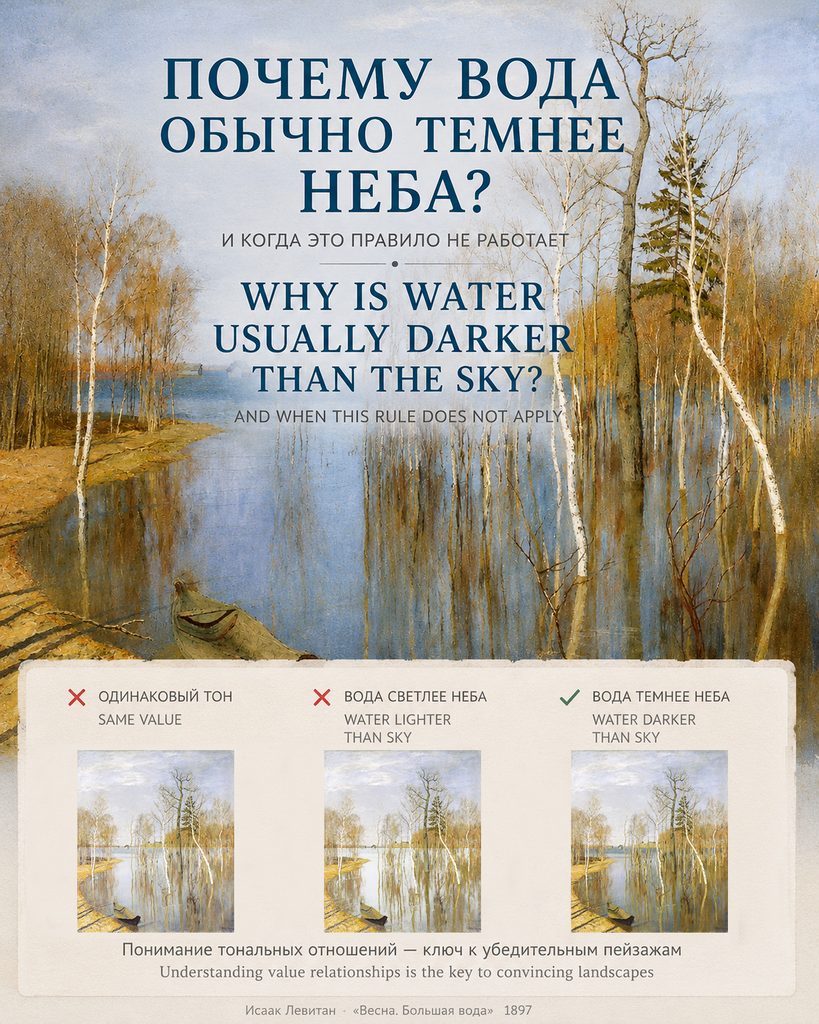
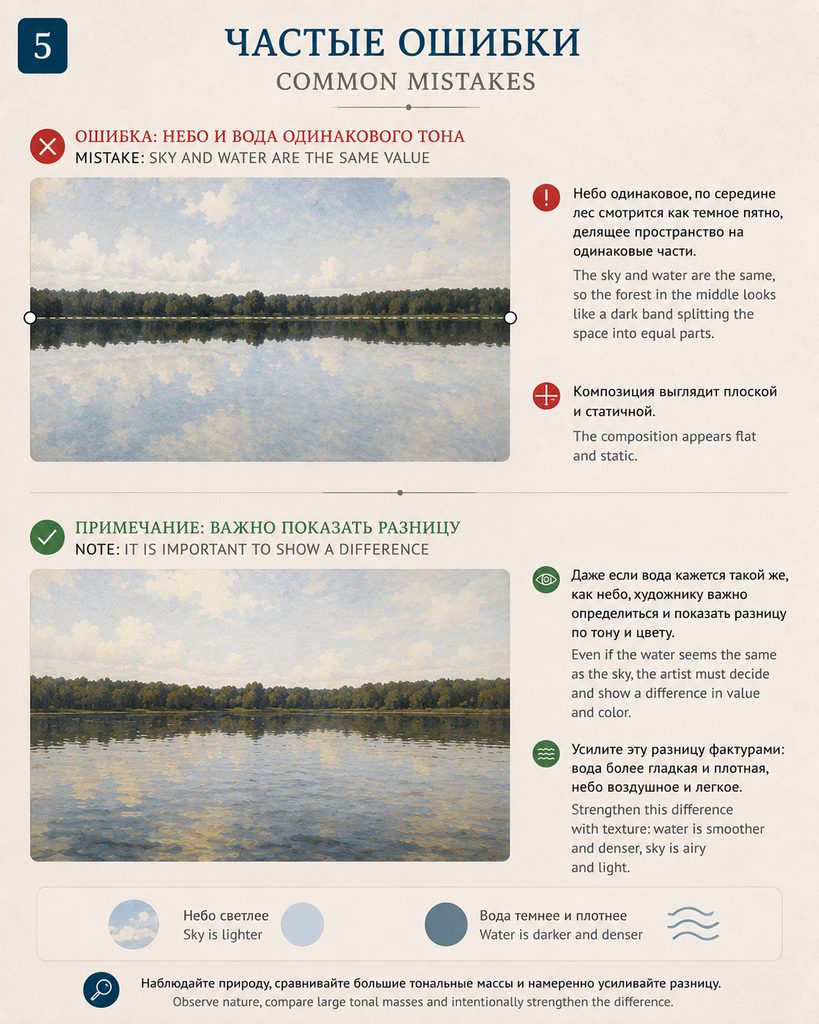
One of the most common mistakes I see in landscape paintings is painting the water with the same value as the sky—or even lighter. At first glance it may seem convincing, but the painting immediately loses its sense of atmosphere, depth, and believable space.
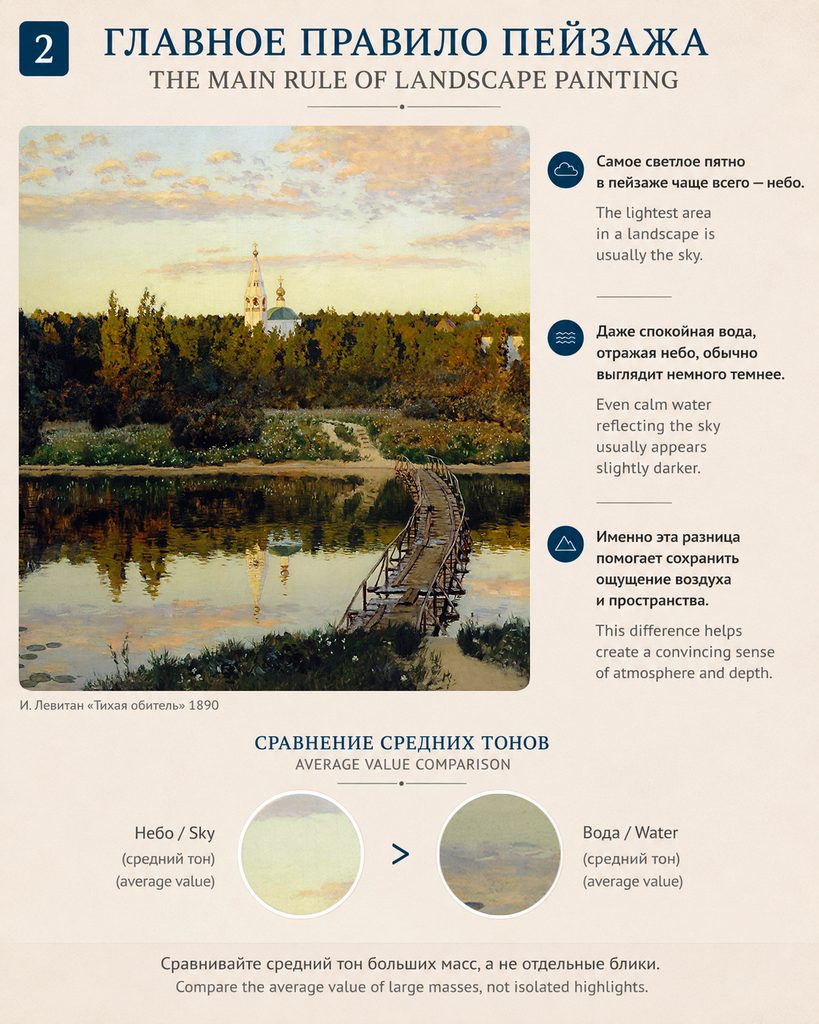
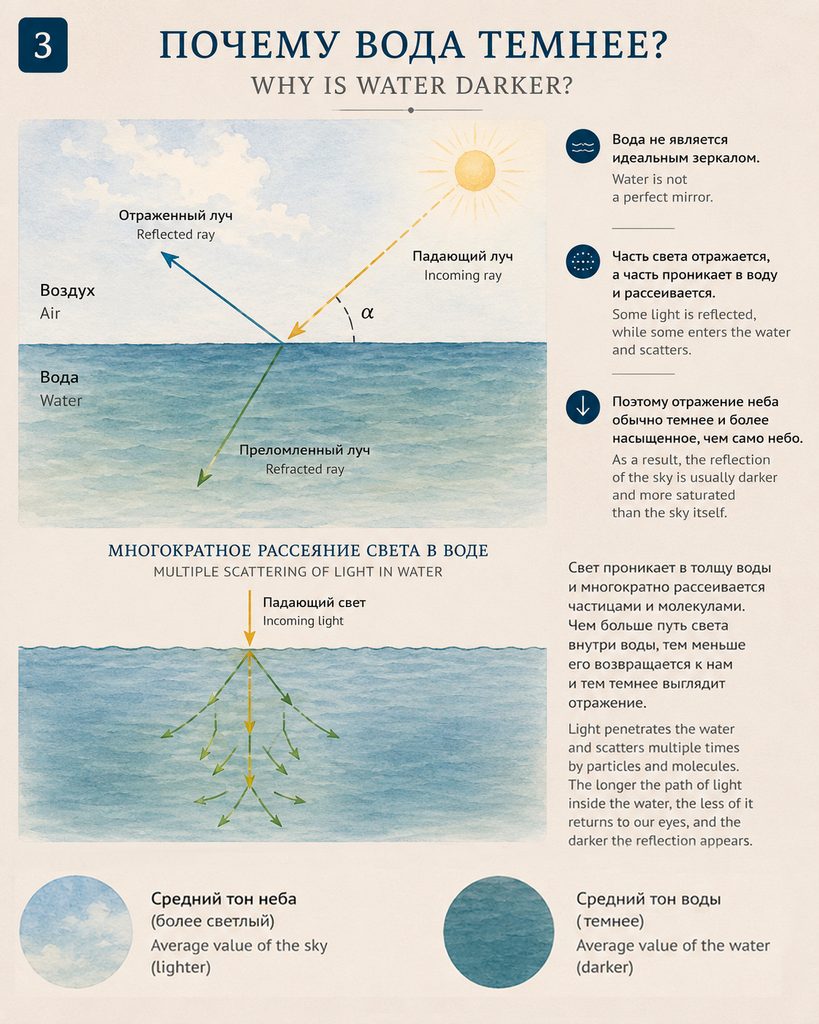
The reason is simple: in most natural conditions, the sky is the lightest element of the landscape. Even when water reflects the sky, it usually appears slightly darker. Water is not a perfect mirror—part of the light is reflected, part enters the water, and part is absorbed. As a result, the reflected image loses some of the original brightness.
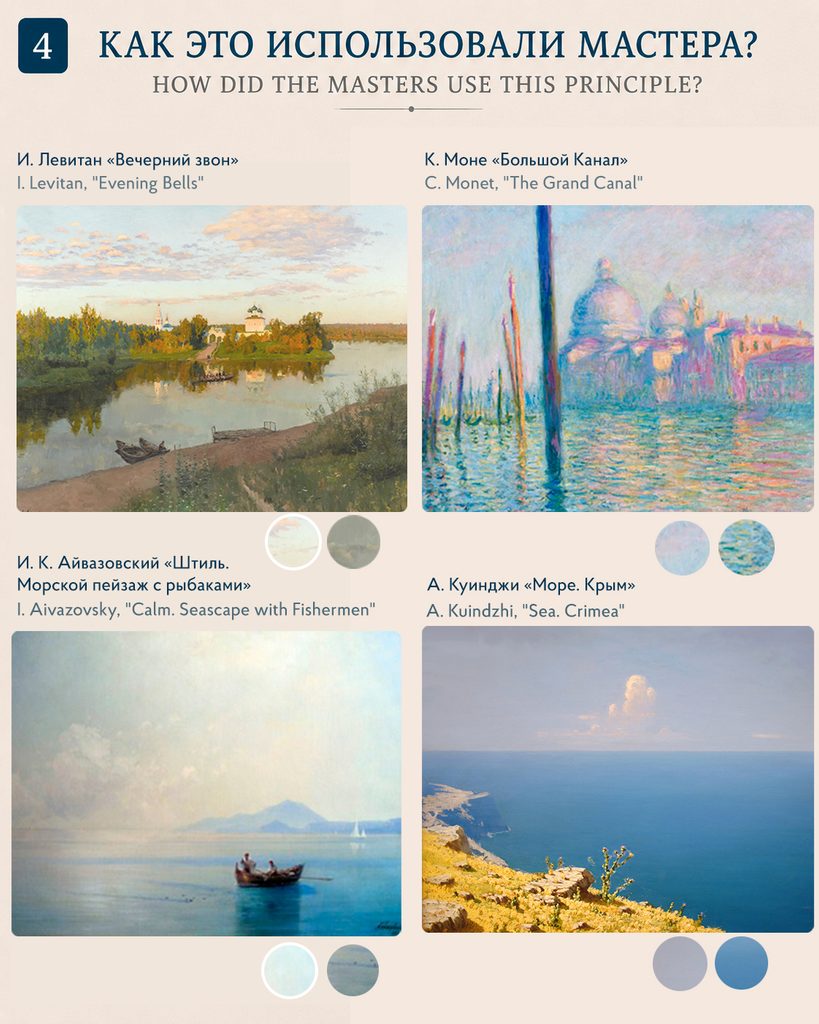
This principle has been observed and taught by many artists and educators. Leonardo da Vinci discussed the behavior of reflections in his Treatise on Painting. John Ruskin emphasized careful observation of water and reflections in Modern Painters. Russian landscape painters such as Nikolai Krymov and Isaac Levitan also taught the importance of accurate tonal relationships for creating convincing light, atmosphere, and depth.
In the carousel, I included diagrams explaining why this happens from the perspective of optics, along with practical examples and common mistakes artists make when painting water.
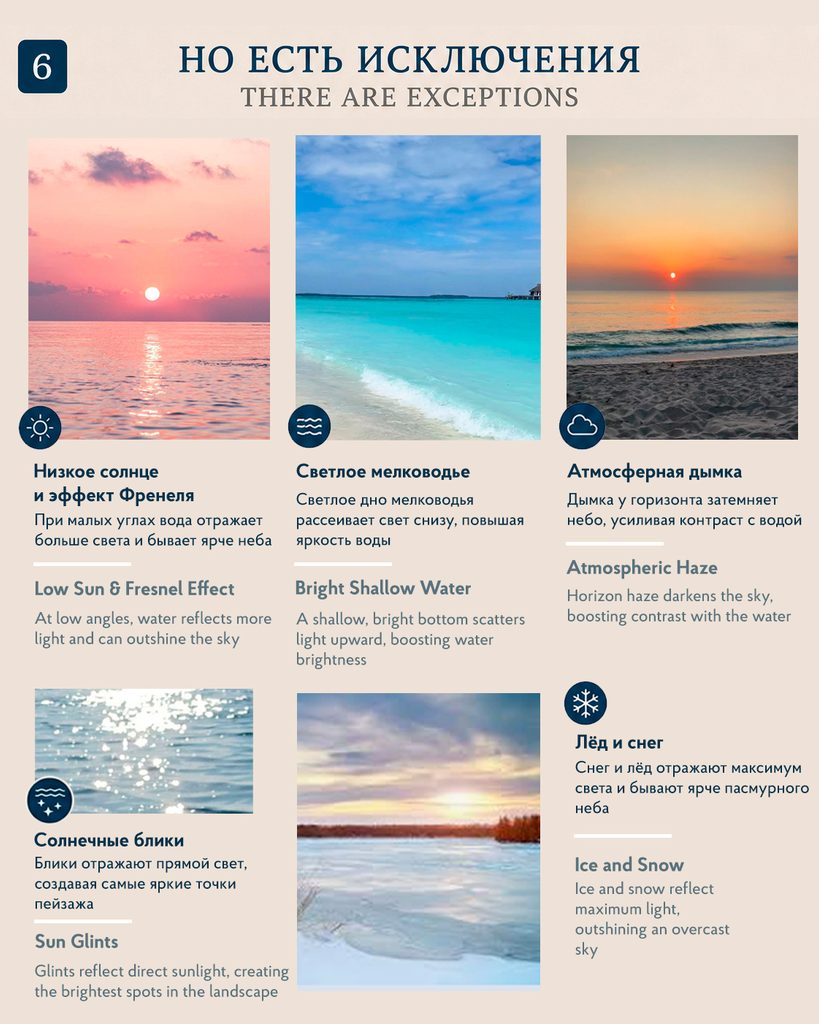
However, this is not an absolute rule. Nature offers fascinating exceptions, and understanding them is just as important as knowing the rule itself.
Some of the most interesting examples include:
- 🏖 Shallow tropical water over white sand. Bright coral sand reflects sunlight back through the clear water, making the lagoon appear brighter than the sky.
- ☀️ Low sun angles (Fresnel effect). At sunrise or sunset, water reflects much more light at very shallow viewing angles, allowing distant water to appear exceptionally bright.
- ✨ Sun glints. Specular reflections of the sun can become the brightest element of the entire landscape, approaching the brightness of the light source itself.
- ❄️ Ice and snow. Frozen surfaces reflect far more light than liquid water and may appear brighter than an overcast sky.
- 🌫 Atmospheric haze. Haze near the horizon often reduces the brightness of the sky while illuminated water retains stronger reflections, increasing the apparent contrast.
- ⛈️ Storm clouds. Dark rain clouds can dramatically lower the value of the sky, while water may still reflect brighter openings between clouds or direct sunlight, making it appear lighter than the sky above.
- ☁️ Overcast conditions. Under a cloudy sky, the tonal difference between sky and water becomes much smaller. In some situations, reflections from brighter parts of the clouds or a light-colored shallow bottom can make the water appear lighter than the surrounding sky.
Understanding these principles allows us to move beyond simply copying a reference and start making conscious artistic decisions.
As artists, our goal is not only to paint what we see, but also to understand why we see it. Once you understand how light, reflections, and tonal relationships work, painting convincing landscapes becomes much more intuitive.
I’d love to hear your thoughts.
Have you ever noticed situations where water appeared brighter than the sky? Which of these exceptions have you observed in nature or used in your own paintings?
🎨 Join my Patreon lessons to put these principles into practice, deepen your understanding of landscape painting, and learn much more about painting water with confidence and accuracy.